
LazAI × XPIN: A Technical Collaboration to Coordinate Real-World Value in DePIN
Abstract
Decentralized Physical Infrastructure Networks (DePIN) are transitioning from proofs of deployment to proofs of value: attribution, pricing, privacy, and transparent rewards. This article explores a conceptual technical collaboration between LazAI - a decentralized web3-native AI infrastructure, and XPIN Network,the Top DePIN project on BNB Chain focused on global connectivity. We investigate how LazAI’s Data Anchoring Token (DAT) technology could map onto XPIN’s decentralized wireless infrastructure to coordinate real-world value. By combining XPIN’s global decentralized network (covering 200+ countries) with LazAI’s DAT and on-chain data evaluation framework, the collaboration would aim to incentivize high-quality data contributions and ensure trustworthy network performance.
We discuss the background of both platforms, the technical integration via DATs, and potential applications – from improving user connectivity experiences to monetizing IoT device data – all from the perspective of LazAI’s data-centric approach.
This partnership highlights how bridging decentralized AI with decentralized telecom infrastructure can coordinate real-world value in a DePIN ecosystem without altering end-user experience, but by transparently aligning incentives and quality of service. In doing so, LazAI will onboard the FreeData Plan and explore how connectivity and AI work together in practice.
About XPIN
XPIN Network delivers decentralized, AI-powered communication infrastructure for secure, efficient, and borderless connectivity. With wireless coverage across 150+ countries and regions, XPIN’s Global eSIM, PowerLink, and AI dNFT introduce a new era of connectivity while unlocking passive income opportunities. By reimagining how the world connects, XPIN is building the next-generation decentralized operator network.
Through these, XPIN Network has pioneered the integration of DePIN and PayFi, creating a self-sustaining economic ecosystem. Through decentralized payment finance (PayFi), everyone can gain long-term free network access by contributing to the network.
This is also one of the key application scenarios of $XPIN. By depositing $XPIN tokens, the interest generated is sufficient to cover the long-term cost of network usage. In this way, global users can support the stability of the network through deposits, without paying any additional fees for the product, realizing the concept of “Buy Now, Pay Never.”
Challenges
Despite these innovations, challenges remain in coordinating real-world value on such networks. Decentralized telecom networks must ensure that service quality (e.g. signal coverage, data throughput, device connectivity) is maintained by a distributed community of operators. How to objectively evaluate and reward quality becomes critical – simply counting hardware deployments or uptime may not capture true performance or data usefulness. There’s also the opportunity to leverage the data generated by the network – from connectivity metrics to IoT sensor readings – as a valuable asset in itself. This is where LazAI Network enters the picture from a complementary angle.
About LazAI (Web3-native AI Infrastructure)
LazAI is a Web3-native AI infrastructure protocol providing a decentralized AI foundation, offering infrastructure, asset protocols, and toolkits to unlock the next generation of personalized AI. Unlike DeFi, which had clear primitives like TVL and APY, the AI field needs new primitives to measure data quality, model performance, and agent reliability LazAI’s solution is to introduce such primitives through its framework, notably the Data Anchoring Token (DAT).
A Data Anchoring Token (DAT) is a novel on-chain token standard designed to assetize data, AI models, and computational results. A DAT is a dynamic semi-fungible standard that can encode rich information about the data asset it represents including provenance, usage rights, and even quality/relevance scores. In essence, a DAT acts as:
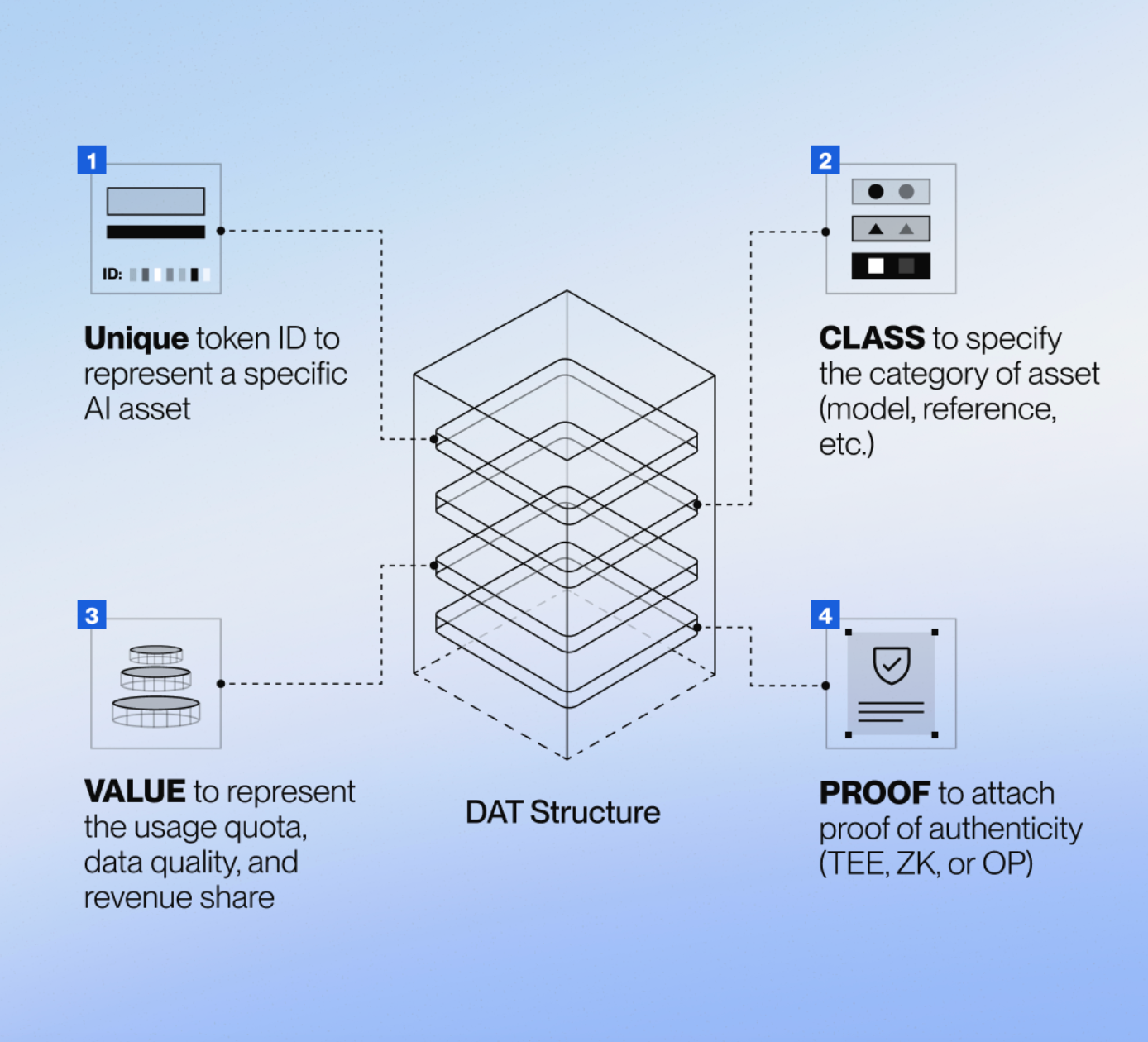
- Proof of Contribution: A certificate of ownership or stake in a particular dataset/model, recording who provided or curated it.
- Usage Right: A programmable allowance for consuming AI services (for instance, a DAT might entitle its holder to a certain number of model inferences or access to a dataset).
- Value Share: An entitlement to future revenue or rewards that the data/model generates, proportional to one’s contribution.
Crucially, DATs carry a “value” field which reflects the evaluated quality and utility of the data. LazAI employs a decentralized evaluation pipeline to assess each data contribution’s integrity and relevance. High-quality, useful data results in a higher on-chain value attribution, which in turn can translate to greater rewards for the contributor. All of this is done in a privacy-preserving manner – using tools like Trusted Execution Environments (TEEs) and zero-knowledge proofs (ZKPs) so that sensitive data can be validated without exposing the raw content.
From LazAI’s perspective, this framework addresses the data quality problem in AI by incentivizing quality data and aligning contributors with model goals. By turning data into a tokenized asset class (via DATs), LazAI sets the stage for an AI-native economy where community-contributed data is transparently valued and rewarded.
The question then becomes: how can such a system interface with a DePIN like XPIN, which operates in the realm of physical connectivity and IoT data?
Technical Walkthrough of the Integration
Mapping LazAI’s DAT Technology onto XPIN’s Network
In a LazAI-XPIN integration, the core idea is that events and data from XPIN’s network would be minted as DATs on LazAI’s platform. This mapping would work in several stages:
- Data Generation at the Edge: XPIN’s network events such as a device attaching to an XPIN eSIM and logging connectivity metrics, or a community-run XPIN Base Station providing coverage in an area produce data. This could be telecom data (signal strength, uptime, throughput) and user QoE data (quality of experience, e.g. whether a video call was smooth). For privacy, raw personal data would stay on the device or be abstracted; only relevant metrics or anonymized aggregates are used.
- Local Evaluation & Packaging: Software running on the device or base station (potentially a LazAI edge agent integrated with the XPIN device firmware or app) performs initial evaluation of the data. For example, a LazAI evaluation model might calculate a network quality score for a session (taking into account signal stability and speed) or verify sensor data consistency. This step filters noise and ensures that only meaningful data is prepared for anchoring. The data is then packaged with metadata (time, location region, device type, etc.) and a tentative quality score.
- Data Anchoring & Tokenization: The packaged data gets anchored on-chain as a DAT. Each DAT represents a unit of contribution to the XPIN network’s operation. For instance, one DAT could correspond to a day’s worth of connectivity logs from a particular base station, or a batch of IoT sensor readings from a device. The DAT token contains references to the data (stored off-chain or in a decentralized storage) and includes the contributor’s identity (or pseudonymous address) and usage rights. At minting, it also includes the initial evaluated value (the quality metric) in its metadata.
- Decentralized AI Evaluation: Once on-chain, LazAI’s network can perform a more robust evaluation of the DAT’s content. This could involve multiple AI models or validators (including potentially other XPIN users or nodes acting as validators) to cross-verify the data’s integrity and usefulness. Because the DAT is on-chain, multiple stakeholders can trustlessly participate in validation.
- Quality Stamping and Value Alignment: After consensus on the data’s quality, the DAT’s value field is updated (or confirmed) on-chain. A high-quality contribution, say a base station that provided 99% uptime and served many users with good throughput would get a high value stamp, whereas a low-quality or dubious report might be assigned a lower value or even rejected (if it falls below a certain trust threshold).
Conclusion
From the perspective of LazAI, a collaboration with XPIN represents a forward-thinking union of decentralized AI and decentralized physical infrastructure. By integrating LazAI’s DAT technology into XPIN’s global wireless network, we illustrate how real-world value can be better coordinated in DePIN ecosystems. The solutions discussed quality-aware rewards for connectivity providers, and AI-driven network optimization, all stem from a simple but powerful principle: when data is transparently evaluated and tokenized, participants at every level can be fairly rewarded for the real value they create.
For XPIN, adopting such an AI-enhanced data layer could mean a more user-centric network. It could continually improve service quality through community feedback loops, and attract privacy-conscious users. For LazAI, it provides a high-impact real-world arena to demonstrate that data quality metrics and alignment incentives are not just theoretical, they can guide the evolution of physical networks and services. In broader terms, this collaboration is a microcosm of a trend where Web3 technologies converge: blockchain provides the trust substrate, AI provides intelligent automation, and IoT/telecom provides tangible utility.
In conclusion, a LazAI-XPIN collaboration hints at the future of DePIN: one where AI-driven analytics and blockchain incentives work hand-in-hand to manage infrastructure more intelligently. Together, they could set a precedent for highly researched, value-focused partnerships in the DePIN space, coordinating not just devices and users, but the very knowledge and insights that drive real-world value.
Disclaimer: The technical approaches described in this article are under active research and development. They are not guaranteed to be finalized, universally feasible, or free of modification. Future iterations of the architecture, schemas, or workflows may differ from what is outlined here. No warranties or assurances of any kind, whether express or implied, are made regarding the technical implementation.


